
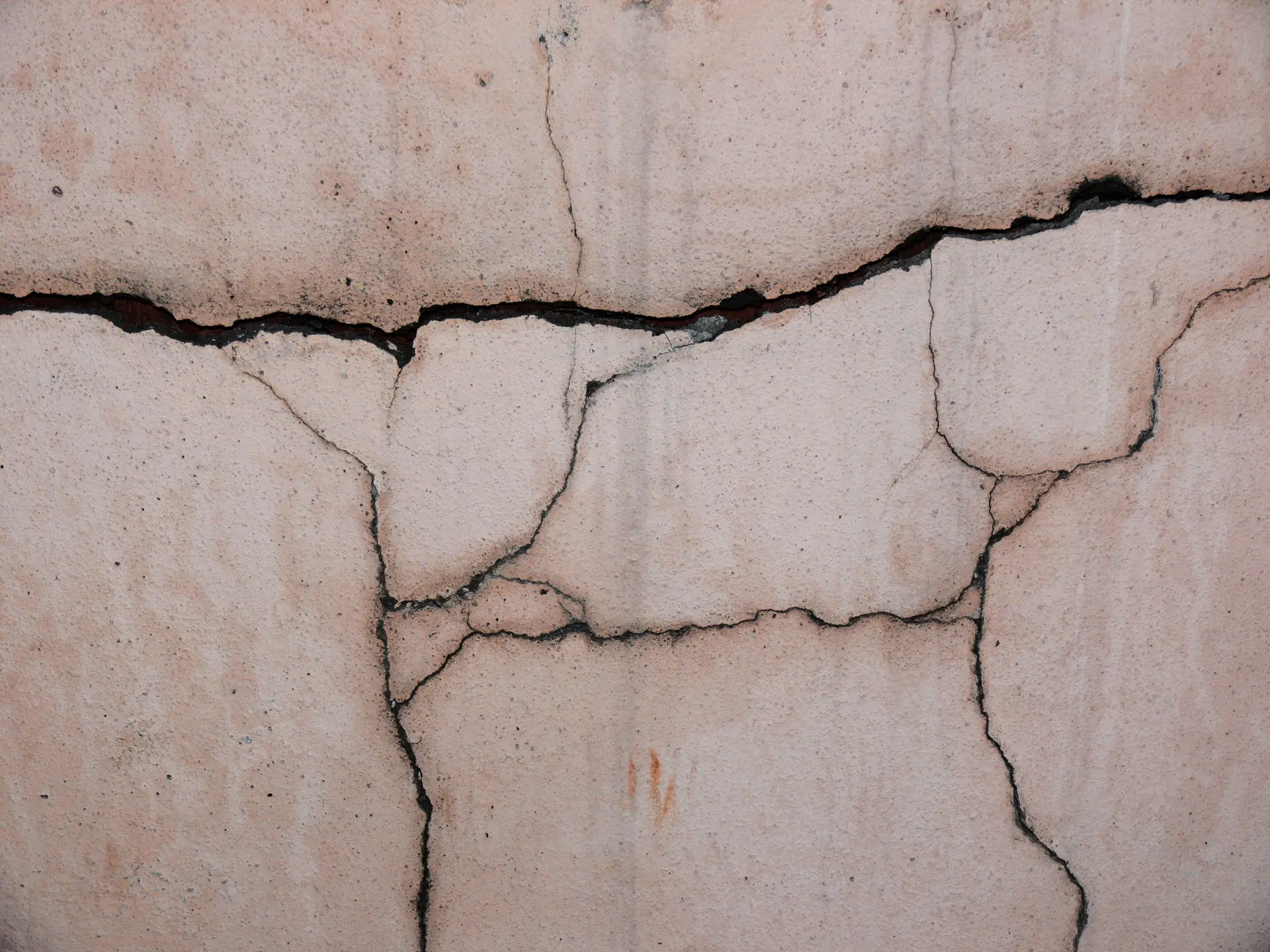
A foundation does one job: it takes the weight of the house and spreads it into the soil. When part of it cracks, settles or comes loose from the framing, that job gets done unevenly, and the house shows it in doors that stick, floors that slope and drywall that keeps cracking in the same place.
This note covers how to tell which signs matter, how repairs differ between the two common foundation types around Los Angeles, and why foundation repair quotes can be so far apart. We work out of Long Beach and inspect foundations across Los Angeles and Ventura Counties, so the examples fit the foundation types found in this part of California.
Cracks that matter and cracks that do not
Concrete shrinks as it cures. Almost every foundation has thin, hairline cracks from that shrinkage, and on their own they rarely mean much. The cracks worth a closer look have a pattern to them.
- Cracks that are getting wider. A crack you can fit a coin into, or one that has opened since you last looked, is moving.
- Cracks with an offset. If one side of the crack sits higher or further out than the other, the footing has shifted.
- Stair-step cracks in block walls. Cracks that follow the mortar joints up and across a block foundation point to settlement or lateral pressure.
- Cracks that run through the footing. A crack visible on the stem wall and continuing down into the footing is more serious than one that stops at the surface.
- Cracks that come with symptoms upstairs. Doors that bind, windows that will not latch, gaps at the top of baseboards and floors you can feel slope are all signs the structure has moved with the concrete.
Look at the framing too. On a raised foundation, the sill plate (the wood board that sits on the concrete) can rot where it stays damp, and posts under the floor can sink or lean. Those problems can make a house sag even when the concrete itself is in decent shape.
Raised and slab foundations: different fixes
Most houses here sit on one of two foundation types, and the repair options follow from that.
Raised foundations have a perimeter footing and stem wall with a crawlspace under the floor. The floor is carried by girders on posts and piers inside the perimeter. Repairs here are often about the parts you can reach from the crawlspace:
- Replacing rotted sill plate and setting new anchor bolts into the concrete.
- Resetting or replacing sunk or leaning posts and piers, with new footings under them where needed.
- Sistering or replacing joists and girders that have sagged.
- Removing and replacing a damaged section of perimeter footing, done in short sections while the house is supported.
Because the framing is accessible, a lot of leveling can be done from below without lifting finished floors. This is also the moment to look at whether the house is bolted and its cripple walls are braced, since the crew is already under the floor. That retrofit has its own section under structural work.
Slab foundations pour the floor and footing together, so there is no crawlspace. Repairs are more involved because the problem sits under finished floors. The engineer's findings set the fix, which might be perimeter underpinning, epoxy injection for structural cracks, or removing and repouring a section of slab. Any of those means lifting flooring in the affected area.
Why two quotes can differ so much
Two foundation repair quotes for the same house can look like they describe different houses. Usually they describe different jobs. These are the main reasons:
- Diagnosis. One contractor may treat the symptom (patch the crack, shim the floor) while another addresses the cause (replace the footing section, reset the posts). Ask each one what they think caused the damage.
- Engineering. Some repairs need an engineer's design and a permit. A quote without engineering may be planning work that the building department would not approve as drawn, or work that does not need a permit at all.
- Scope boundaries. Does the quote include restoring the finishes it disturbs? Drywall patching, flooring, landscaping and stucco can add up.
- Unknowns. Hidden rot or a footing in worse shape than it looks are possible on any foundation job. A good quote says how those discoveries will be handled and priced.
Line the quotes up item by item: what is being repaired, how, who designs it, whether a permit is included and what finish work comes after. If one quote lists items the other does not mention, ask the other contractor about them directly.
Engineering and permits
Small repairs, like replacing a short run of sill plate or resetting a few posts, can sometimes be done without engineering. Larger work, such as replacing footing sections, underpinning or structural slab repair, needs a design from a licensed engineer and a building permit from the city. In Long Beach that is the city's own building department, and in the City of Los Angeles it is LADBS. Unincorporated areas go through the county.
The permit brings inspections at set stages, typically before concrete is poured and at the end. That inspection record is worth having when you sell the house.
How we inspect and quote
Our inspection starts outside, looking at the stem wall, grading and drainage, then moves into the crawlspace or along the slab. We check the sill plate, anchor bolts, cripple walls, posts, piers, girders and joists, and we note doors, windows and floors upstairs that point to movement. If engineering is needed, we bring an engineer in before the quote is final.
The written quote lists each repair on its own line, says where engineering and permits apply, and separates structural work from the finish work that follows. If a retrofit makes sense alongside the repair, it is listed as a separate item so you can decide on it with the full picture. If you are also planning a room addition or a larger remodel, planning both at once avoids opening the same floor twice.